
Verified Maywood Directory Collections
Maywood has several strong city directory leads, but no verified continuous shelf run. The table separates an actual catalog record from titles found only in official bibliographies. That distinction prevents a citation from being mistaken for an open scan.
| Collection | Years | Where Held | Access |
|---|---|---|---|
| Official Directory of Maywood, Illinois, Allan Reid Parrish | 1898 | NPS bibliography; ask Maywood Public Library | Bibliographic lead; scan or holding not confirmed |
| Maywood and Its Homes, Village of Maywood | 1904 | NPS and IDOT citations; library inquiry | Bibliographic lead; full digital copy not located |
| Maywood and Melrose Park city directories | 1917 | FamilySearch film 2310377, DGS 9179888 | Catalog and microfilm; image access may require a center or library |
| Maywood Village Directory, City Directory Publishing Company | 1954 | IDOT historic survey citation | Holding or scan not confirmed; ask library |
| Maywood Herald obituary card index | 1885-2002 | Maywood Library and FamilySearch | Digitized surname cards; account or center may be needed |
No official shelf list confirmed a Maywood reverse-directory series, telephone supplement, missing-year pattern, or last printed year. Ask the library about the same volume before assuming those sections exist. The 1917 FamilySearch catalog is the firmest city directory record.
The captured catalog page confirms the title and microfilm identifiers, but it does not display a named directory entry.
Maywood Library Holds Local Memory
The Maywood Public Library local-history page identifies an archive and strongly recommends making an appointment. Ask for a defined surname, address, and year range. Request the title, page, image, reel, card, or clipping citation with any copy. The library also points researchers to Cook County Vital Records, Illinois State Archives, NARA, Newberry Library, Chronicling America, and the General Land Office.
The building explains why local material may have survived outside a county portal. The library was founded in 1874. Its Carnegie building opened in 1906 after a 1904 response and 1905 dedication. A 1936 PWA remodel, a 1998 annex, and later restoration created a combined 43,000-square-foot library with local-history and board space in the Carnegie building.
Directories, obituary cards, clippings, housewalk programs, and local ephemera may require staff help. No separate current Maywood Historical Society catalog was verified, so the library, preservation commission, and official bibliography are the safer paths.
Note: An appointment request should name the person, address, date range, and exact Maywood collection lead rather than ask for all family material.
Maywood Directory Years in Context
A short timeline shows why the historical shelf is fragmented. It also keeps a directory year from being treated like a current address statement.
| 1870 and 1875 | NPS bibliography identifies early Maywood promotional publications; physical copies need confirmation. |
|---|---|
| 1898 | Allan Reid Parrish’s Official Directory of Maywood, Illinois appears as a bibliography lead. |
| 1904 | Maywood and Its Homes supplies an address and institution lead, though a full scan was not located. |
| 1917 | The Maywood and Melrose Park city directory has a FamilySearch microfilm catalog record. |
| 1954 | An IDOT survey cites a Maywood Village Directory from City Directory Publishing Company. |
Sanborn atlases fill part of the space between these points with building and street evidence from 1895 and a cited 1905-1951 sequence. They are map sources, not lists of residents. Federal census schedules through 1950 supply dated households under the 72-year access rule.
Read a Maywood Directory Entry
The 1917 catalog was inspected, not an entry image. The fields below are therefore a transcription checklist based on the verified catalog and standard directory structure, not a claim that every field appears in that volume. Photograph the title page and abbreviation key before interpreting initials or marks.
| Identity | Surname, first name or initials, spelling as printed, and possible spouse or widow notation |
|---|---|
| Address | House number, street, unit or room if printed, and any separate street-order line |
| Context | Occupation, professional line, employer, institution, or business if the volume prints it |
| Placement | Directory year, page or image, film/DGS, publisher, and alphabetic, address, or business section |
| Linked evidence | Earlier or later directory, obituary card, census, parcel, deed, newspaper, or vital index |
- Criss-cross directory
- A street-and-house-number arrangement used to find listings at an address. Its presence in the Maywood volume must be checked.
- Householder index
- An index centered on the person listed as the household head, which may omit others at the address.
- Abbreviation key
- The volume’s own list of shortened terms and symbols. It controls how the entry should be read.
A printed city directory entry is evidence for its publication period. It is not proof of legal ownership or of every household member, and its street text may need to be normalized against a map.
Bridge Maywood Directories to Obituaries
The Maywood Herald obituary card index covers 1885 through 2002 and cites 62,054 images from the Maywood Public Library. Search a surname from the directory, record the card’s date and name details, and then seek the newspaper item. The card is an index lead, not the full obituary or a city directory.
An obituary may add relatives, an organization, a funeral date, or a place that separates two people with the same initials. Follow those facts into the period newspaper and, where eligibility rules permit, the Cook County vital or genealogy channel. Never merge people solely because a surname and village match.
Illinois death-index guidance offers an insider advantage: try official spelling variants such as Mc/Mac, O, Du, De, La, and Le. Save each variant searched and keep negative results. A spelling change can explain why a directory name appears to vanish.
Maywood Civic Sources Are Leads
NOMCO has operated since 1968, meets in different Maywood places, and provides public meeting and contact information. Its site does not publish a member directory. Use the organization to understand a neighborhood event or civic setting, not to infer that a named person belonged to it.
The Maywood Historic Preservation Commission storymap, published in 2024, adds place-based context for 87 properties and 17 National Register references. It can identify a building or organization that belongs in a library or newspaper search. The successful NOMCO capture shows the verified civic-history route.
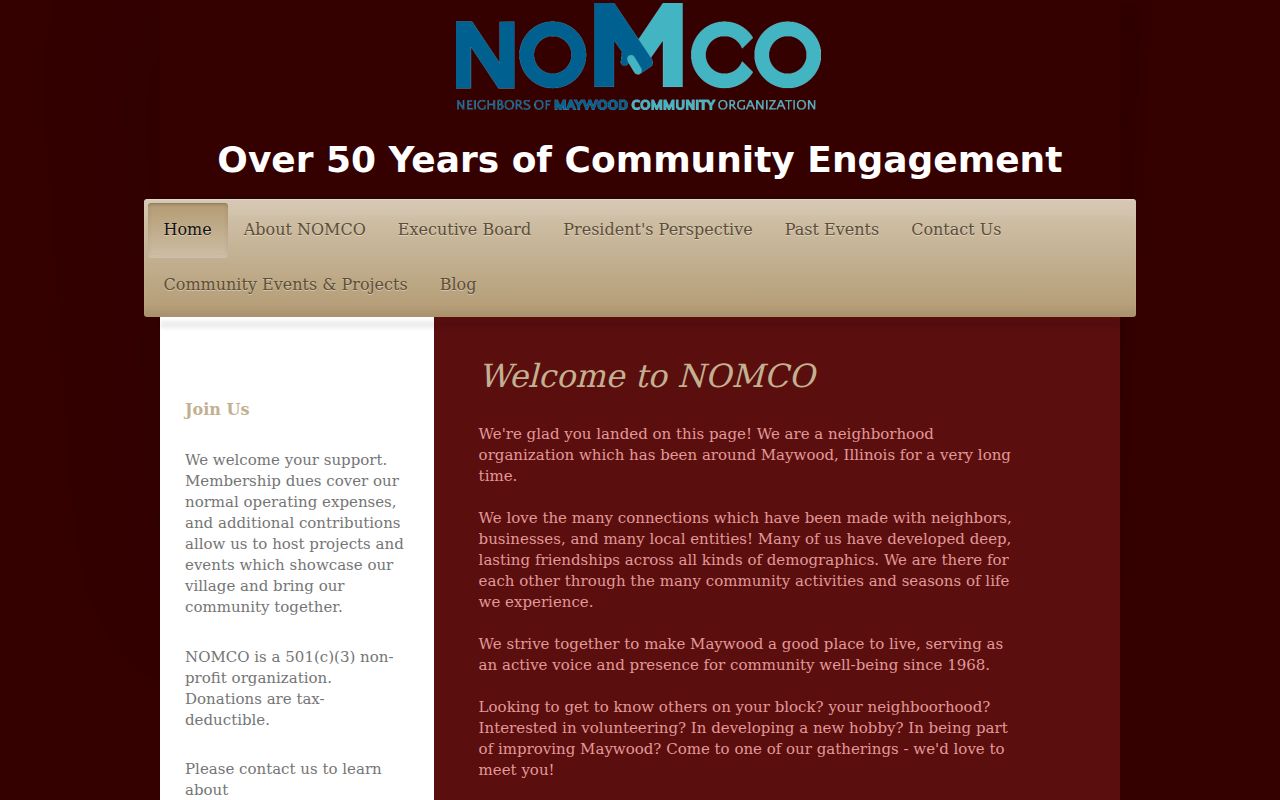
The image supports the organization’s public history and contact role. It does not support a list of members or residents.
Fill Maywood Directory Gaps
When no city directory survives for a target year, switch record types without pretending they are interchangeable. A Sanborn sheet can establish a building footprint and use. A census can identify a dated household. The Maywood Herald card can point to an obituary. A naturalization or probate index can add a court date and file number. Each source answers one part of the question.
The Cook County IRAD holdings search lists naturalization indexes, final papers, probate case-file indexes, administrator bonds, letters, and related material through the Northeastern Illinois University depository. Request or view the underlying file before turning an index line into a family fact. For federal schedules, NARA’s public individual census access currently runs through 1950.
Maywood’s record gaps reflect ordinary fragmentation, not a verified courthouse fire. One office holds a modern index, another may hold paper instruments, the library keeps local items, and an archive preserves older government series. State the gap plainly when the scan, shelf location, or reverse section was not found.
Trace Family Through Maywood Directories
A Maywood city directory works best as one dated point in a longer family timeline. Begin with the most certain surname, address, or year and copy the entry exactly. Do not modernize the spelling in the transcript.
- Find the exact surname and likely spelling variants in a verified Maywood volume or cataloged reel.
- Record the title, publisher, year, page or image, film/DGS, full printed address, and all marks.
- Compare the closest earlier and later directory that can be located. Note a move, widow notation, changed initials, or absence without guessing why.
- Pair the directory with the closest public census schedule. Use the street, enumeration district, ages, and relationships to test identity.
- Search the Maywood Herald cards, newspaper, vital index, cemetery, probate, or naturalization records for an endpoint or same-name check.
Disappearance from a city directory may mean death, a move, a missed volume, changed spelling, exclusion from publication, or restricted image access. An obituary date or later census can support one explanation. Silence alone cannot. For modern parcel research after a historical address is found, use the Maywood street directory workflow and keep the current record separate from the old listing.